Explore All Articles
Explore All Articles


Coenzyme Q10 (CoQ10) is one of the most frequently discussed supplements in fertility medicine—and for good reason. Its role in cellular energy production and antioxidant defense makes it biologically relevant to egg health, particularly as eggs age.²,⁷
If you’re newer to the topic and want a broader foundation on what CoQ10 is and how it works throughout the body, our Learning Center article What Is Coenzyme Q10? Its Benefits for Health, Energy, and Aging offers a helpful overview.
At the same time, enthusiasm has often outpaced evidence. To understand where CoQ10 genuinely helps—and where its benefits remain uncertain—it’s essential to separate mechanism from outcomes and promise from proof.
Here’s what the research currently supports:
As a physician, one of the most common—and emotionally loaded—questions I hear is:
“Is there anything I can do to improve my egg quality?”
Egg quality matters because it influences fertilization, early embryo development, and chromosomal stability. Unlike sperm, eggs are finite—we are born with all we will ever have. Over time, both egg number and functional quality decline, with measurable changes often beginning in the late 20s and accelerating in the mid-to-late 30s.2,8
This is also why supplements that support cellular energy and antioxidant defenses—like CoQ10—have drawn so much attention in reproductive medicine.
Still, before discussing strategies, one clarification is essential:
Improving egg quality markers does not automatically mean improving the chance of a live birth.1,2
Many interventions—including supplements—can influence cellular behavior, laboratory measures, or early pregnancy signals without ultimately changing whether a healthy baby is born. Understanding this distinction sets the stage for interpreting CoQ10 research responsibly.
To appreciate why CoQ10 is so often discussed in fertility care, it helps to zoom in to the cellular level.
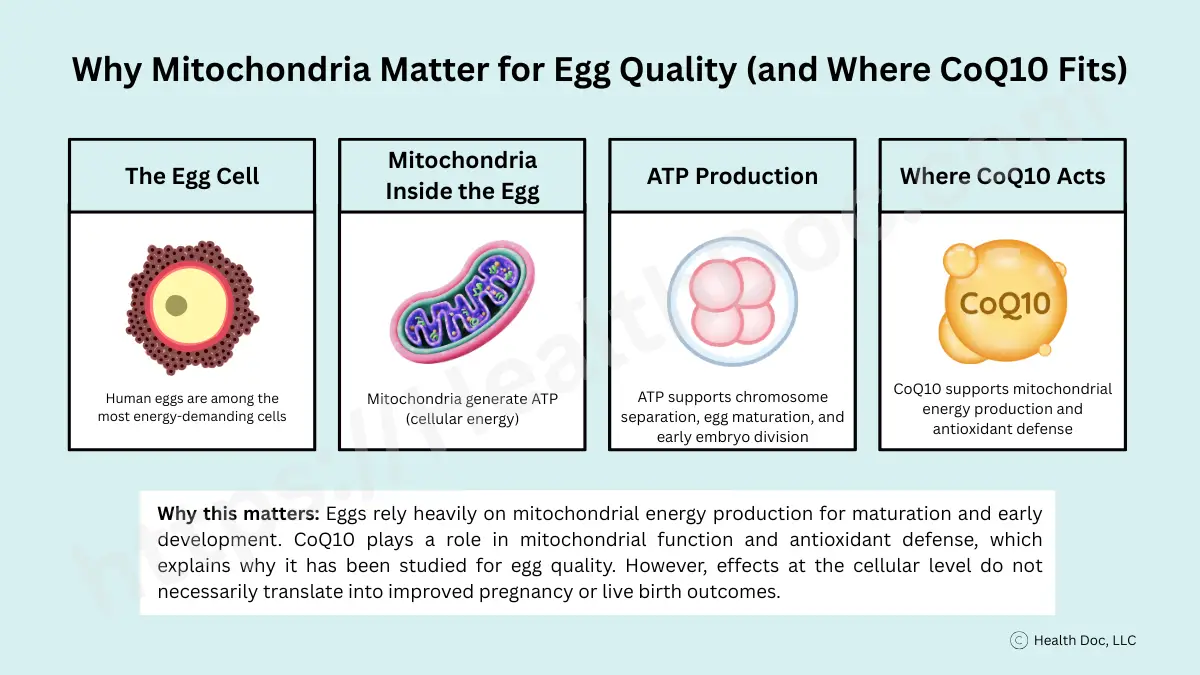
Eggs are among the most energy-dependent cells in the human body. They rely heavily on mitochondria to produce ATP—the energy currency required for:
CoQ10 plays a central role in ATP synthesis.2,7 If you’d like a deeper dive into this process across tissues—not just eggs—you may find our article CoQ10’s Role in ATP Synthesis and Energy Production helpful.
With reproductive aging, mitochondrial efficiency declines, and endogenous CoQ10 levels also decrease. Animal studies show that CoQ10 supplementation can restore mitochondrial function and improve egg competence in aging oocytes. These findings provide strong biological plausibility, though they are not the same as clinical proof in humans.7
Oxidative stress can be thought of as cumulative cellular “wear and tear.” Eggs are especially vulnerable because they must maintain DNA integrity over decades.2,8
CoQ10 serves a dual function:
For readers interested in how oxidative stress affects the body more broadly, our Learning Center article CoQ10: A Powerful Ally Against Oxidative Stress explores this mechanism in greater depth.
Age-related increases in chromosomal abnormalities are a major driver of infertility and miscarriage. By supporting mitochondrial efficiency and reducing oxidative stress, CoQ10 may indirectly help protect DNA integrity within the egg.9,11
That said, when this hypothesis has been tested clinically, results have been mixed. At least one randomized IVF trial found no difference in live birth rates, even though some intermediate markers improved—underscoring why outcome selection matters when interpreting fertility research.9
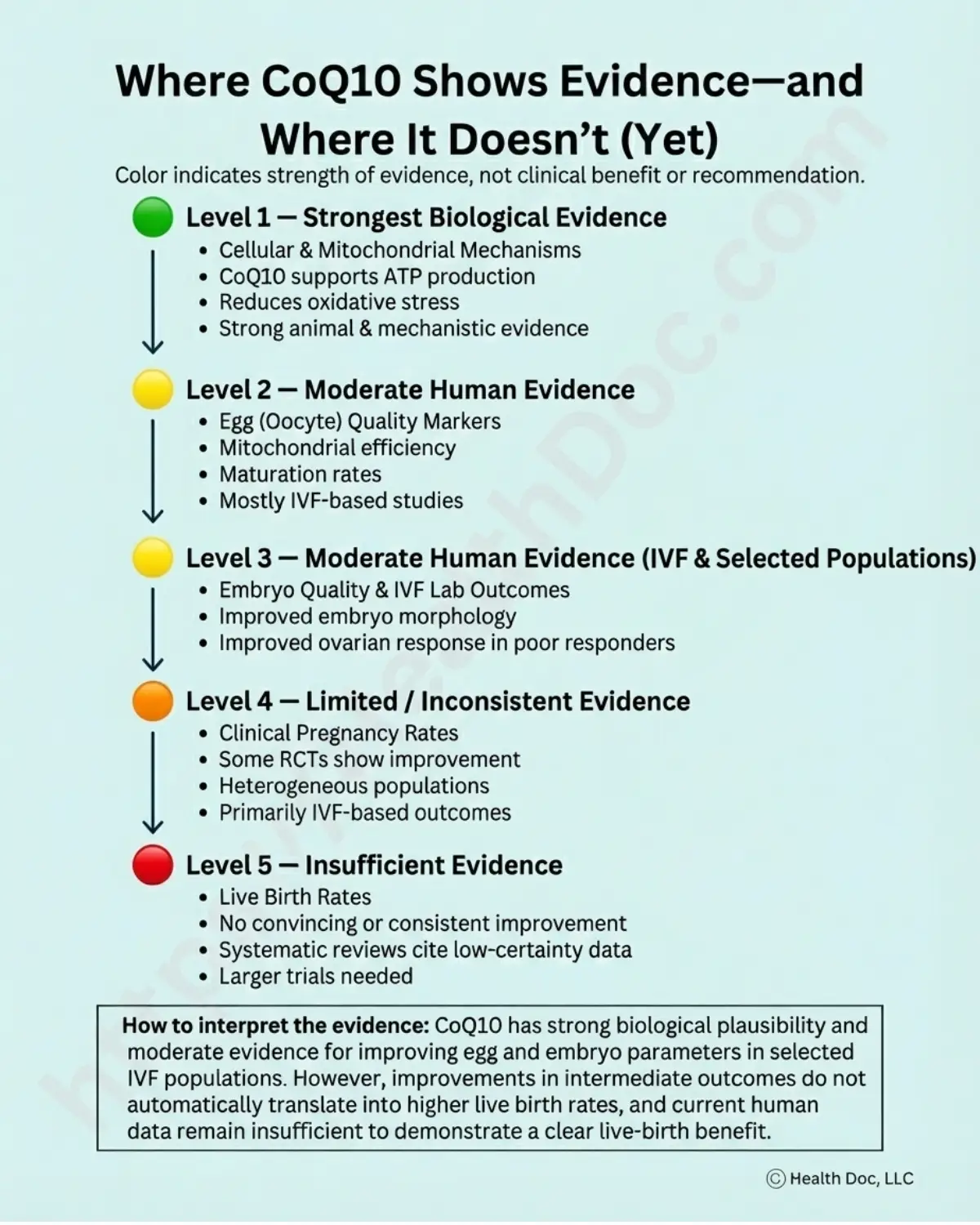
To make sense of CoQ10 studies, outcomes need to be viewed in tiers.
Across multiple small randomized trials and observational studies—primarily in IVF settings—CoQ10 supplementation has been associated with:
These effects appear most consistent in women with diminished ovarian reserve or poor ovarian response undergoing assisted reproduction.
Readers looking for a more IVF-specific discussion may also find value in CoQ10 for Increasing IVF Success: Boosting Fertility and Embryo Quality in our Learning Center.
This is where interpretation often goes astray.
While several studies report higher clinical pregnancy rates, systematic reviews consistently conclude that evidence is insufficient to demonstrate a benefit for live birth rates (LBR).1,2,8
Multiple recent expert reviews describe CoQ10 as promising for egg and embryo parameters, while clearly stating that its effect on live birth remains unproven due to small, heterogeneous trials and lack of LBR-powered studies.1,2
In practical terms: CoQ10 may help eggs and embryos function more efficiently—but whether this leads to more babies born is still unknown.
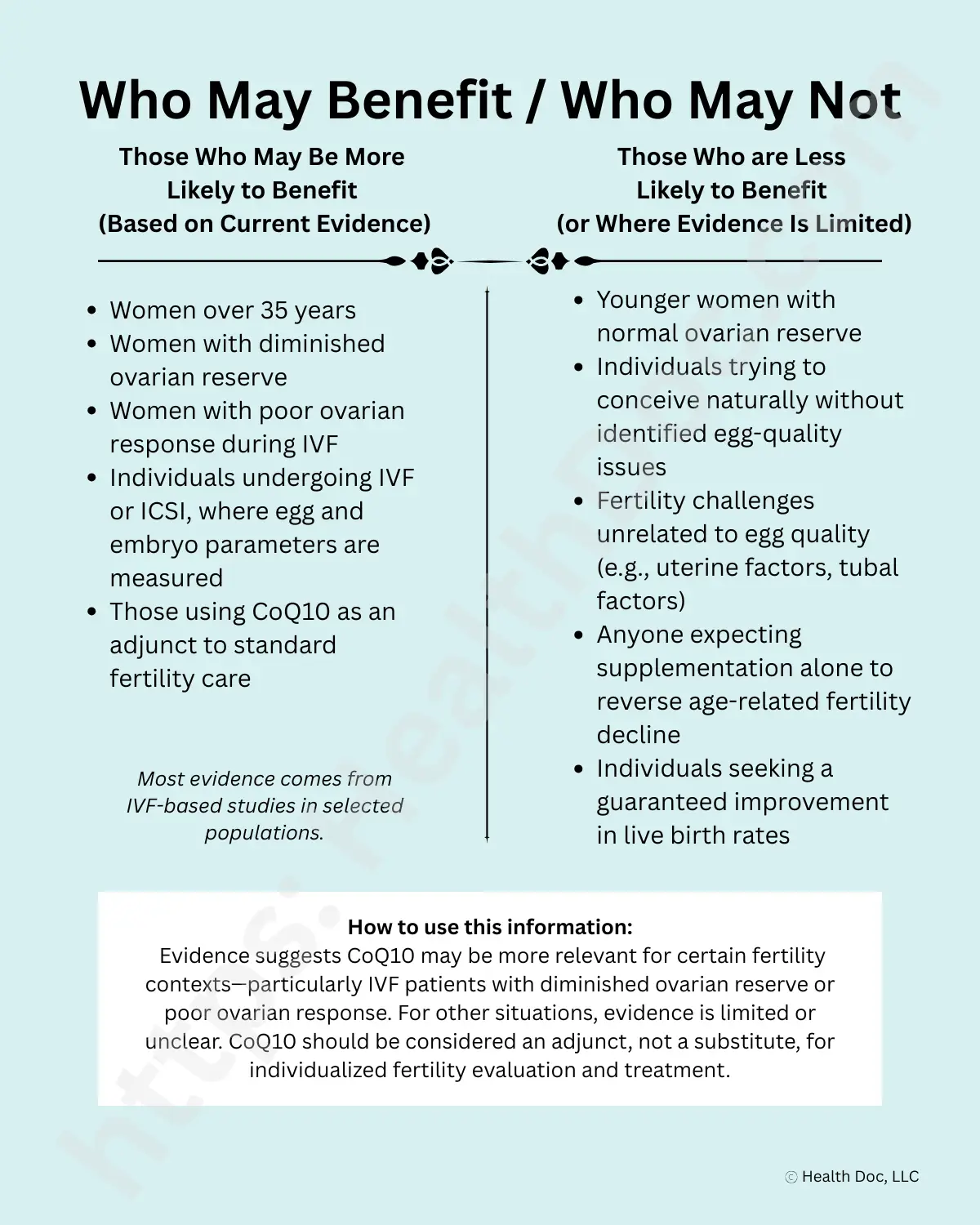
Based on current evidence, CoQ10 appears most plausibly helpful for:
CoQ10 is less clearly beneficial for:
Because fertility involves both partners, some readers may also be interested in our related articles CoQ10 and Sperm Quality and Can CoQ10 Boost Male Fertility? Science Says Yes—Here’s How.
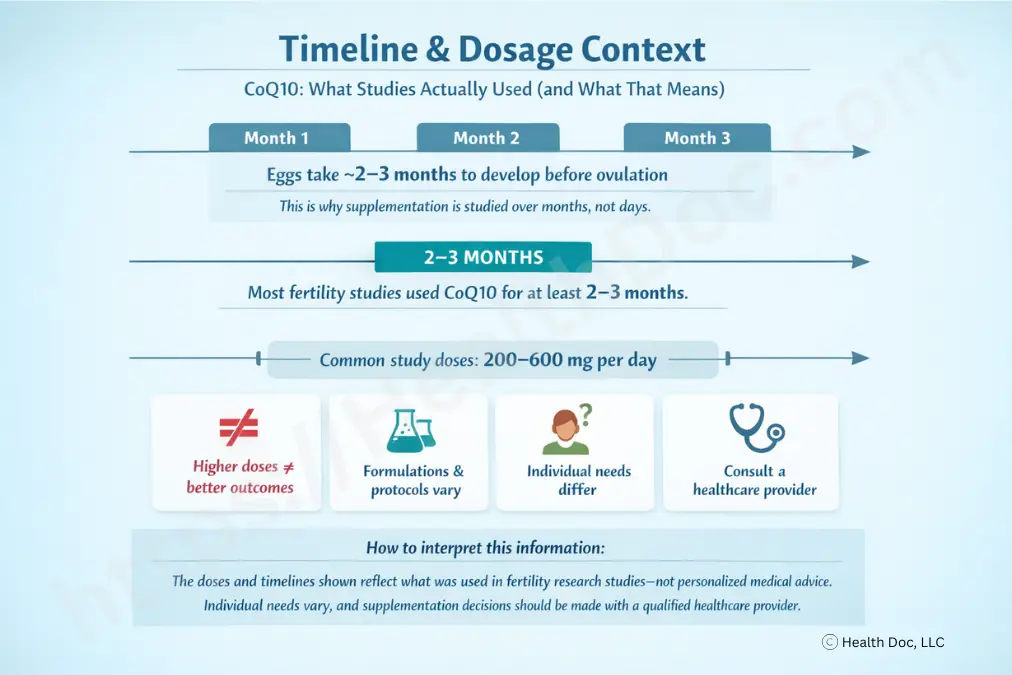
Most fertility studies evaluated CoQ10 at doses of 200–600 mg per day, typically for at least 2–3 months, reflecting the timeline of follicle development.⁴,⁵,¹²,¹⁷
Higher doses have not been shown to produce better outcomes.¹²
Despite encouraging signals, important questions remain:
For readers curious about CoQ10 forms and absorption, The Three Faces of CoQ10: Understanding Ubiquinone, Ubiquinol, and Semi-Ubiquinone provides additional context.
Most fertility studies use 200–600 mg per day, typically for at least 2–3 months, reflecting the natural timeline of follicle development.⁴,⁵,¹²,¹⁷
Higher doses have not been shown to produce better outcomes.¹²
For a deeper breakdown of dosing strategies, absorption, and personalization, see CoQ10 Dosage Explained: How Much Should You Really Take?
CoQ10 should be viewed as supportive, alongside:
CoQ10 is not a fertility treatment, a substitute for IVF, or a guarantee of pregnancy or live birth.
Its role, based on current evidence, is adjunctive—not curative.
Some clinicians and companies—including ours—offer CoQ10 supplements. While product quality matters, no specific brand has been shown to improve fertility outcomes, and individuals should feel free to choose any reputable option or none at all.
If, after reviewing the evidence in this article and discussing your individual situation with a qualified healthcare provider, you decide that CoQ10 supplementation may be appropriate for you, product quality and dosing consistency do matter.
Our team offers a high-quality CoQ10 supplement formulated to support mitochondrial function and antioxidant activity. While no supplement can guarantee fertility outcomes, this option may be appropriate for individuals seeking a reliable CoQ10 product as part of a broader, clinician-guided fertility plan.
👉 You can learn more about our premium CoQ10 supplement here.
As always, supplementation should be individualized and used as an adjunct, not a replacement, for evidence-based fertility care.
CoQ10 is one of the most biologically plausible and extensively studied supplements for egg quality. Human data support improvements in intermediate IVF outcomes and clinical pregnancy rates in selected populations, but a definitive benefit for live birth has not yet been demonstrated.
For many individuals, that makes CoQ10 a reasonable, low-risk adjunct—as long as expectations remain aligned with what the science actually shows.
As fertility research evolves, recommendations may change. For now, informed, evidence-based use—paired with individualized medical care—remains the most reliable approach.
Coenzyme Q10 is a naturally occurring compound involved in mitochondrial energy production and antioxidant protection. Because eggs are highly energy-dependent cells, CoQ10 has been studied for its potential role in supporting egg function, particularly as mitochondrial efficiency declines with age.
There is no strong evidence that CoQ10 alone increases natural conception rates. Most human data come from IVF settings and focus on intermediate outcomes like egg or embryo quality. CoQ10 may support underlying cellular processes, but it should not be viewed as a standalone fertility solution.
Some studies show improvements in egg maturation, embryo quality, and clinical pregnancy rates in selected IVF populations, particularly women with poor ovarian response. However, a consistent improvement in live birth rates has not been demonstrated, and CoQ10 is considered an adjunct—not a proven IVF success enhancer.
At this time, no convincing evidence shows that CoQ10 improves live birth rates. Multiple systematic reviews and recent expert analyses conclude that available trials are too small or heterogeneous to establish a clear live birth benefit.
Most fertility studies use CoQ10 for at least 2–3 months, which corresponds to the time required for egg development. Longer use has not been proven superior, and duration should be individualized with guidance from a healthcare provider.
Doses studied in fertility research generally range from 200–600 mg per day. Higher doses are not necessarily more effective, and optimal dosing may depend on age, ovarian reserve, and overall health.
Both forms have been studied. Ubiquinol is the reduced, more bioavailable form, but there is no definitive evidence that it leads to better fertility outcomes than ubiquinone. Choice of formulation is often based on absorption, tolerance, and clinician preference rather than outcome data.
There is insufficient evidence to conclude that CoQ10 reduces miscarriage risk. While it may influence egg and embryo quality markers, miscarriage outcomes—like live birth—have not been consistently improved in clinical trials.
CoQ10 is generally well tolerated and has a favorable safety profile. Still, anyone undergoing fertility treatment should discuss supplementation with their reproductive specialist to avoid interactions or inappropriate dosing.
*The listed doses are what was used in the referenced research studies. They are not to be taken as individualized medical advice. I am a doctor, but I am not your doctor. Always talk to a healthcare provider who knows you, your medical history, and health goals before making changes to your health regimen – especially if you have any health conditions or are on any medications.
.webp)
Whether you are much interested in investing, our collection of articles is designed to educate and empower you.

